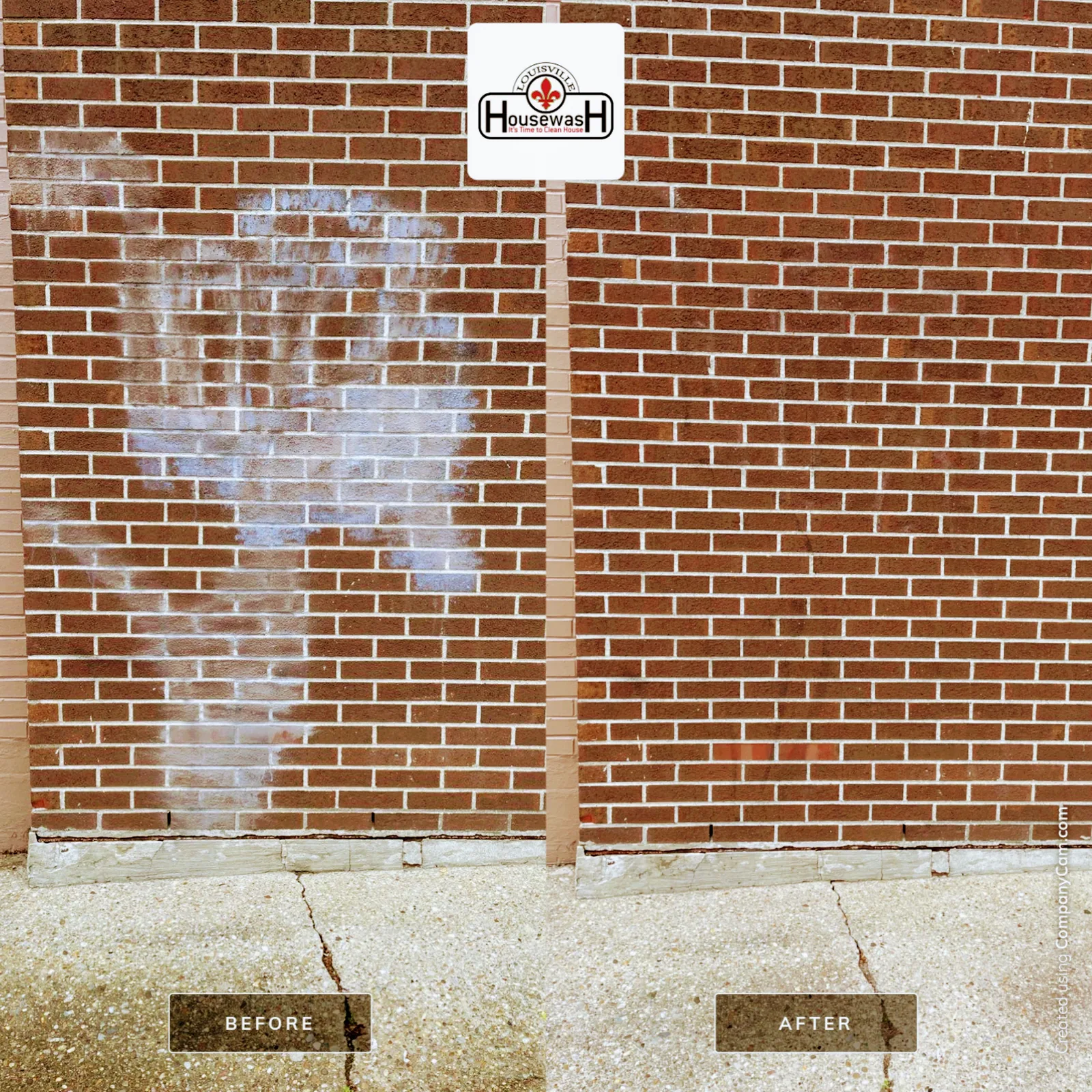
Brick is Louisville's most common exterior material — and one of the most frequently damaged by improper pressure washing. Here's how professional soft washing cleans brick properly without touching the mortar.
Why brick is different from vinyl
Vinyl siding is a modern extruded material with a smooth, sealed surface. Brick is a fired clay product with a porous surface that absorbs moisture, atmospheric pollutants, and biological growth far more readily than vinyl. That porosity is also what makes brick so vulnerable to high-pressure water: it doesn't shed force the way a hard, smooth surface does — it absorbs it.
High-pressure water aimed at brick doesn't just clean the surface. It drives water into the brick face and into the mortar joints. Wet mortar that has softened under pressure is then physically eroded by the water stream. On older Louisville homes — pre-1970 construction with soft lime-based mortar — this erosion can be severe. Once mortar joints are compromised, water infiltration, freeze-thaw cycling, and structural issues follow.
Louisville has thousands of brick homes built in the 1940s through 1970s in neighborhoods like St. Matthews, the Highlands, Crescent Hill, Clifton and Butchertown. These homes have lime mortar that's far softer than the Portland cement mortar used in modern construction. They require soft-wash treatment — not a pressure stream — for safe exterior cleaning.
What grows on Louisville brick homes
The biological growth on brick homes in Louisville typically falls into three categories:
- Algae: The green color that appears on north and east-facing brick surfaces. Green algae thrives in humid, shaded conditions — exactly the kind found on the shaded faces of homes under Louisville's extensive tree canopy. It appears first as a faint green haze and progresses to visible streaking if left untreated.
- Mildew: The dark gray-black streaking most common on soffits, under roof overhangs, and on brick surfaces with limited airflow. Mildew is a surface fungal growth that's often confused with dirt but doesn't come off with a simple rinse.
- Lichen and moss: Less common than algae and mildew but present on shaded brick in older neighborhoods. Lichen is a symbiotic combination of fungus and algae that attaches firmly to masonry and requires longer dwell time with stronger chemistry to fully kill.
All three respond well to soft-wash treatment with a properly diluted sodium hypochlorite solution and sufficient dwell time. The solution kills the organisms at the root; the low-pressure rinse removes them without disturbing the mortar.
Efflorescence on Louisville brick
Many Louisville brick homes develop efflorescence — white or gray mineral deposits on the brick face caused by salt migration through the masonry. Efflorescence isn't biological growth; it's minerals that have dissolved in water, moved through the brick, and been deposited on the surface when the water evaporated. It looks like a white haze or chalk-like deposits, often near the base of walls, around windows, or in areas of persistent moisture.
Soft washing alone won't remove efflorescence — it requires a mild acid treatment (typically an oxalic or citric acid-based cleaner) to dissolve the mineral deposits before rinsing. If you have white staining on your brick in addition to biological growth, mention it during your estimate and we'll assess whether an efflorescence treatment is appropriate.
How long does a soft-washed brick home stay clean?
In Louisville's climate, most properly soft-washed brick homes stay visibly clean for 12–24 months. The longer end of that range applies to homes with good sun exposure, minimal tree canopy overhang, and good airflow around the exterior. The shorter end applies to heavily shaded north faces, homes near the Ohio River with elevated ambient humidity, and brick surfaces with persistent moisture issues from grading or gutter problems.
The key word in both cases is "properly" soft-washed: a treatment that kills the biological organisms at the root rather than simply rinsing them off the surface. Homes that have been rinsed without proper chemistry typically see regrowth within 3–6 months. A professionally soft-washed home stays cleaner because the colony is dead, not merely displaced.
Getting a quote for brick cleaning in Louisville
Louisville pressure washing is our specialty, and Louisville brick runs the full range — from small 1940s bungalows in Germantown to large estate homes in Anchorage. Every brick home gets a proper assessment before we start: we look at the mortar condition, note any spalling or damaged brick faces, identify the type and extent of biological growth, and plan the appropriate pressure and chemistry for the specific surfaces.
Call or text (502) 777-8024 or use the quote form on our site for a free estimate on your Louisville brick home.
— The Louisville Housewash Crew
Recognizing when your brick needs cleaning
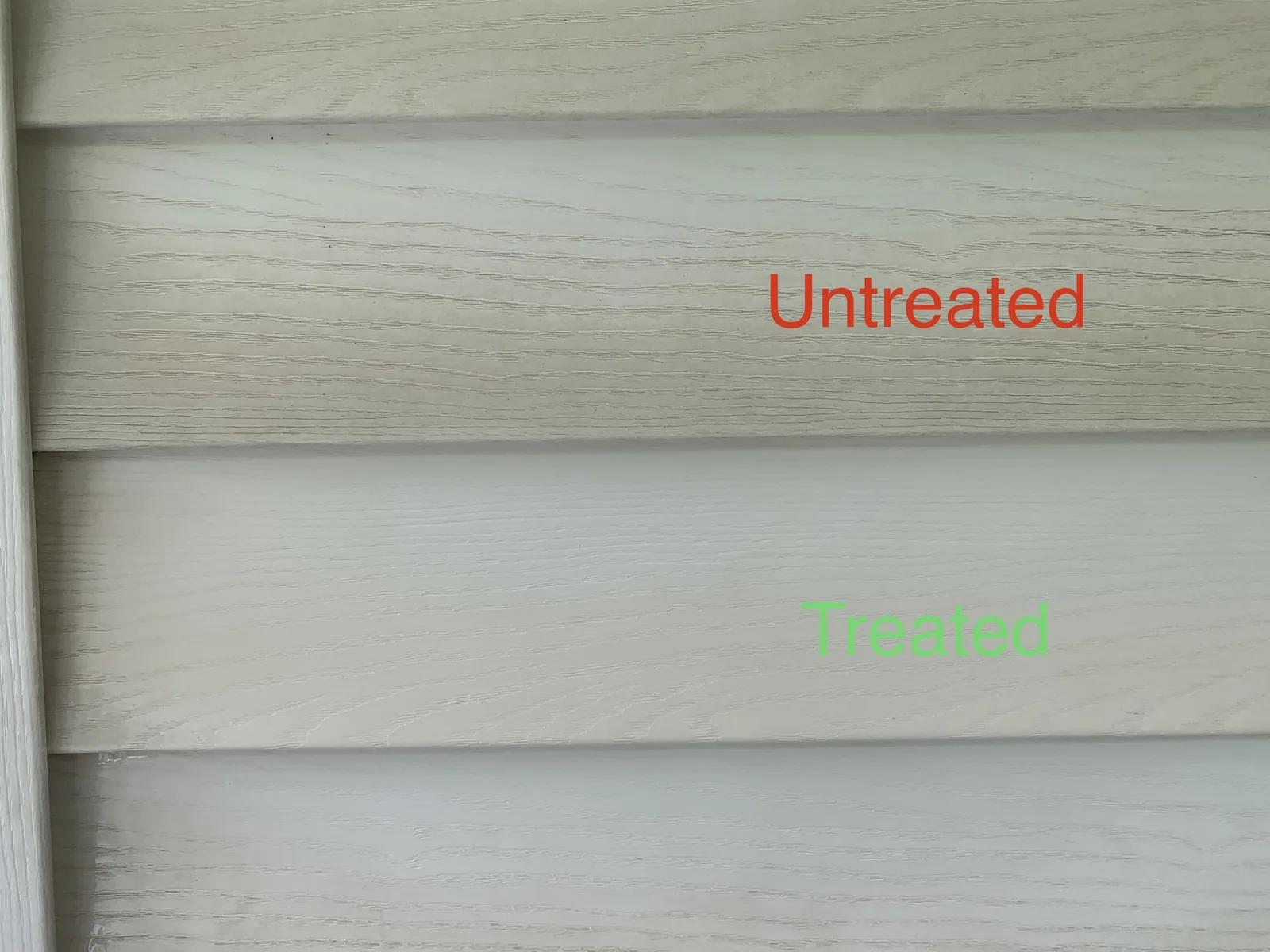
Louisville brick homes often develop staining gradually enough that homeowners stop seeing it — the change happens over months and years, and the eye adjusts to the new baseline. The clearest way to see what your brick actually looks like versus what it could look like is to find a shaded, protected section of the home (under a deep overhang, behind a permanent fixture) that hasn't been exposed to the same weather and biological growth. Compare that protected section to the most exposed face of the home. That difference is what cleaning restores.
The most common trigger that gets Louisville homeowners to schedule brick cleaning: listing the home for sale, hosting an event, noticing the neighbors had their brick cleaned and realizing the difference, or an HOA notice about exterior maintenance. Any of these is a perfectly good reason to call. You don't need to wait for an emergency.
Pre-cleaning assessment: what we look for on brick
Before any solution touches a brick home, we do a brief assessment of the masonry condition. Specifically, we're looking for: areas where mortar is already cracked, crumbling or missing — which need to be noted so we avoid concentrated solution in those areas and can flag them for repair; any spalling brick (brick faces that are delaminating or flaking) that may indicate moisture damage or freeze-thaw cycling; evidence of previous high-pressure damage such as pitting, erosion or "sandblasted" appearance on brick faces; and any recent tuckpointing or masonry repair work that should be given time to cure before cleaning.
Finding these issues before we start is part of the estimate process. If we see masonry problems that should be addressed before or after cleaning, we'll note them for you — not as a sales tactic, but as information that will help you maintain the home's structural integrity.
After the cleaning: what to expect
Freshly soft-washed brick has a noticeably brighter, more uniform appearance than brick covered in years of biological growth. The warm red-brown tones of the clay brick return; the mortar joints look lighter and cleaner. Most Louisville homeowners are genuinely surprised by the transformation, even on homes they thought were "just a little dirty." The difference is visible from the street immediately after cleaning.
The other thing to expect: some areas may look cleaner than others initially. Heavily shaded north faces with deeply established growth may take a second treatment or a follow-up rinse after a few rain events to reach the same baseline as sun-exposed sides. We'll point this out if we see it and let you know whether a follow-up is warranted or whether the residual staining will clear on its own. Call or text (502) 777-8024 for a free estimate on your Louisville brick home.
Maintaining Louisville's historic brick neighborhoods
Louisville's brick architecture is part of what makes neighborhoods like Old Louisville, Germantown and the Highlands historically significant. These homes represent genuine 19th and early 20th century craftsmanship, and their brick and masonry deserve maintenance practices that protect that material for the next generation of owners. High-pressure washing on historic brick is genuinely harmful — we've seen brick faces damaged and mortar eroded on homes that were subjected to modern pressure washing equipment that simply wasn't appropriate for the age and condition of the masonry.
Soft washing isn't just the right choice for these homes — it's the responsible one. A properly executed soft wash with appropriate low-pressure application and biodegradable chemistry extends the life of historic brick and mortar rather than degrading it. If you own a pre-1970 Louisville brick home and have been hesitant to have it cleaned out of concern for the masonry, soft washing is the method that eliminates that concern. Call (502) 777-8024 for a free estimate and honest conversation about what your specific home needs.
Protecting your investment in Louisville brick
A Louisville brick home is a long-term asset. The materials that make up its exterior — brick, mortar, painted trim, caulk and weatherstripping — all have maintenance requirements that, when met, extend the home's value and structural integrity for decades. Regular soft washing is the maintenance item that protects the brick and mortar specifically. It costs a fraction of what masonry repair costs and prevents the kind of biological degradation that leads to expensive tuckpointing and repointing work. Call (502) 777-8024 to schedule your free estimate.
If you have questions about whether your Louisville brick home is a good candidate for soft washing — especially if you have an older home with historic masonry — call (502) 777-8024 before booking. We're happy to answer questions over the phone and will be honest if a site visit is needed to assess the masonry condition before committing to service.