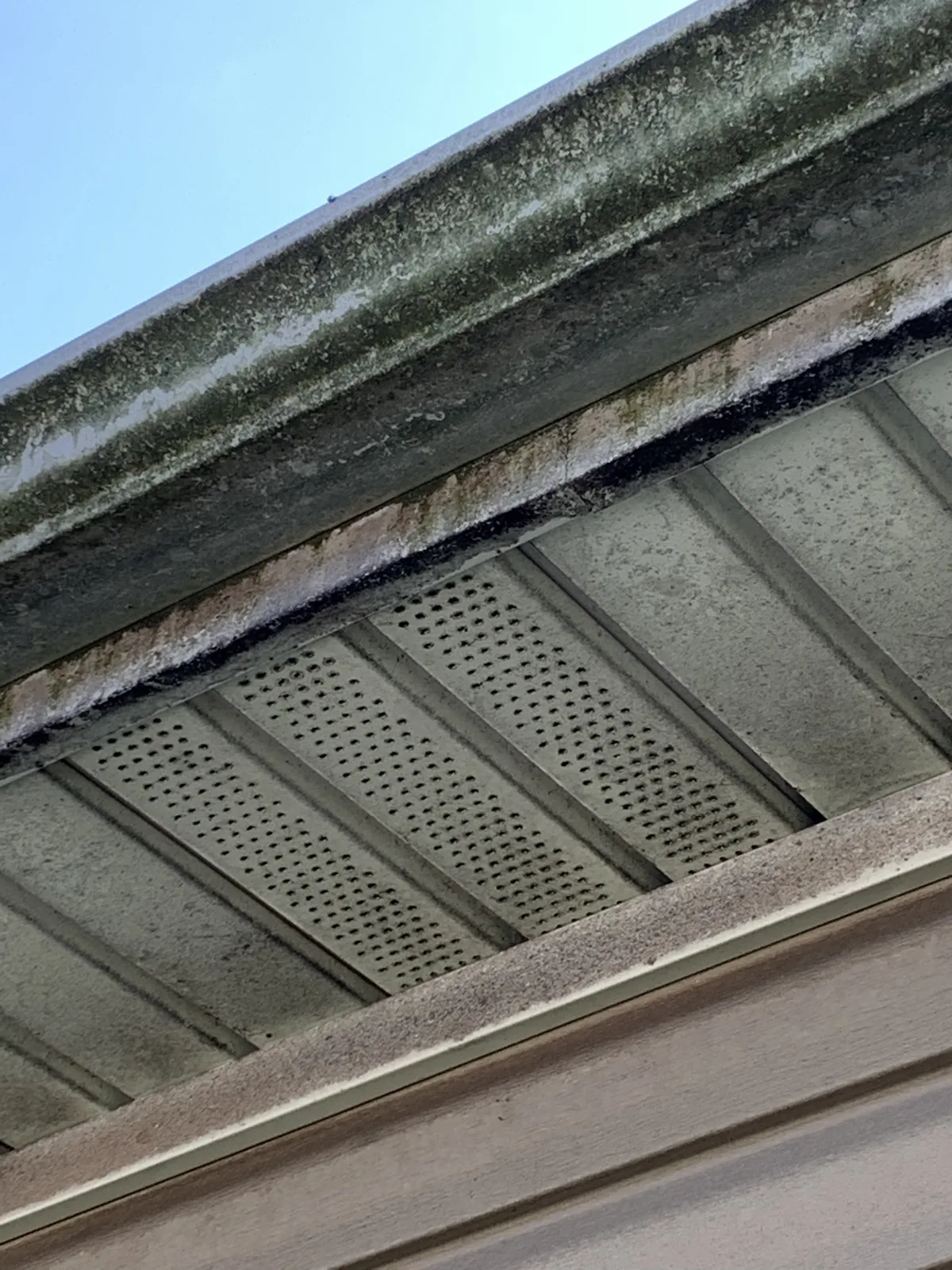
What are those black streaks on Louisville roofs?
The dark black or gray streaking that appears on asphalt shingle roofs — running in vertical lines from the ridge toward the gutters — is caused by a specific organism: Gloeocapsa magma, a cyanobacteria (photosynthetic bacteria, sometimes loosely called algae) that feeds on the limestone filler in asphalt shingles. Louisville's humid climate and warm summers provide ideal conditions for this organism to spread, and once established on a roof, it will continue expanding year after year unless killed at the source.
The streaking is most visible on lighter-colored shingles and on the north and west faces of the roof that get less UV exposure. It's also more common in neighborhoods with heavy tree canopy that keeps the roof shaded and damp — exactly the conditions found in many of Louisville's established residential neighborhoods.
One thing to know up front
We don't offer roof cleaning.
This guide is here because it's one of the most common questions we get on Louisville house washing jobs — homeowners look up at the black streaking and ask whether we can take care of it. We can't, and we'd rather explain what it is and how it should be treated than pretend otherwise.
If you need your roof cleaned, look for a company that specializes in soft-wash roof treatment. If your siding, deck, driveway or windows need attention, that's us.
Why Gloeocapsa magma is more than cosmetic
This is a point where homeowners sometimes underestimate the issue. The dark staining looks cosmetic, but Gloeocapsa magma is actually feeding on the limestone granule coating in asphalt shingles. As the bacteria colony grows and spreads, it consumes the granule filler, weakening the shingle structure and accelerating UV degradation of the asphalt layer beneath.
Shingles in Louisville that have heavy biological growth are aging faster than their labeled lifespan assumes — because that lifespan is based on weathering, not biological degradation on top of weathering. Regular roof cleaning extends the functional life of a shingle roof and protects the manufacturer's warranty (many shingle warranties are voided by biological growth that's allowed to establish).
Beyond the shingles themselves, the damp conditions that support biological growth also encourage moss and lichen development. These organisms develop root structures that physically lift shingle tabs over time, allowing water infiltration under the shingles. Moss on a Louisville roof is a more urgent problem than algae streaking because of this physical damage mechanism.
The correct method for roof cleaning
Roof cleaning should be done exclusively with soft-wash technique. Pressure washing an asphalt shingle roof — regardless of the nozzle or pressure used — strips granules from the shingle surface. Those granules are the shingle's UV protection, fire resistance, and primary weathering layer. Removing them accelerates aging dramatically; high-pressure roof cleaning can take years off a shingle roof's life in a single cleaning session.
Soft washing uses low pressure combined with sodium hypochlorite-based cleaning solution, applied at concentrations appropriate to kill Gloeocapsa magma and other biological growth without damaging the shingle surface. The solution is applied, allowed to dwell (the kill time for the bacteria), and rinsed at low pressure. Results are visible immediately — the dark streaking fades as the organisms die and rinse away — and continue improving over the following weeks as residual dead material washes off with rain.
What to expect after soft washing your roof
Immediately after treatment, the most heavily stained areas will be visibly lighter. Some staining may persist for a few days to a few weeks as the dead biological material breaks down and washes away. This is normal — it's not incomplete cleaning, it's the biology of how dead organisms detach from a surface over time. By the time 2–3 rain events have rinsed the roof, the results are fully realized.
Moss and lichen take longer to fully clear than algae streaking because their root structures are more embedded. Treatment kills them, but the dead growth doesn't immediately disappear — it dies in place and gradually loosens over weeks to months. A roof with heavy moss may benefit from a follow-up treatment or gentle brushing several weeks after the initial treatment.
How often does a Louisville roof need cleaning?
Most Louisville roofs in established neighborhoods with tree canopy benefit from cleaning every 3–5 years to prevent biological growth from establishing. Roofs in full-sun locations with minimal shade may go longer. Once algae streaking is visible, the growth is already well-established; cleaning as soon as you notice it (rather than waiting until it looks severe) results in faster and more complete removal.
Some homeowners pair roof cleaning with a regular house soft wash of their home's exterior. The two services complement each other, but they're handled by different specialists — the roof work is done by a roof-cleaning company, and the siding by a house washing crew. If you're scheduling both, book them as separate visits and coordinate the timing.
Choosing someone to clean your roof
Since we don't do this work, here's what we'd look for if it were our own house:
- They soft wash. If a company proposes pressure washing an asphalt shingle roof, walk away — it strips the granules and takes years off the roof.
- They carry insurance that specifically covers roof work, and they'll show you the certificate without being pushed.
- They set honest expectations about recovery time. Anyone promising a spotless roof the same day on heavy moss is overselling.
- They can explain how they protect landscaping and gutters from the runoff.
Moss vs. algae: different treatments, different timelines
Many Louisville homeowners use "algae" and "moss" interchangeably when describing roof discoloration, but they're different organisms with different cleaning approaches and different timelines for results.
Algae (including Gloeocapsa magma) is a surface-level organism with no root structure. Soft washing kills it and the discoloration from dead algae washes away within a few rain events — typically 2–4 weeks after treatment. Results are visible within days and complete within a month.
Moss has a physical root structure (rhizoids) that embeds into the shingle surface and between shingle layers. Soft washing kills the moss, but the dead moss doesn't release from the shingle immediately — it dies in place and gradually loosens over weeks to months as rain and weather break it down. On a heavily mossed Louisville roof, you might not see the full results for 2–3 months after treatment. This is normal and expected; it's not incomplete cleaning. Some cases benefit from gentle brushing of dead moss 6–8 weeks after treatment to accelerate removal.
Lichen — the crusty, often white or gray patches that look like they're embedded in the shingle surface — is the most stubborn. Lichen forms a tight mechanical bond with the granule surface and may require multiple treatments over time for complete removal. Heavy lichen coverage on a Louisville roof is an indicator that the roof has been neglected for a long time and the granule surface beneath the lichen may be compromised.
Will cleaning void my shingle warranty?
This is a genuine concern worth addressing. Most major shingle manufacturers — including GAF, Owens Corning, and CertainTeed — explicitly acknowledge that biological growth voids their warranty because it accelerates shingle degradation. The same manufacturers recommend or require soft washing as the approved cleaning method. High-pressure washing, by contrast, voids most shingle warranties because of the granule loss it causes.
If your roof is under an active manufacturer warranty (typically 25–50 years for architectural shingles), soft washing with appropriate chemistry is the approved method for cleaning, and maintaining a clean roof is typically required to keep the warranty in force. Allowing biological growth to establish and damage the shingles is what voids the warranty — not the cleaning.
If you're unsure about your specific warranty terms, check your shingle documentation or contact the manufacturer.
Louisville neighborhoods where roof algae is most common
While Gloeocapsa magma can establish on any Louisville roof, certain neighborhoods see it more frequently due to their specific microclimate characteristics:
The Highlands, Crescent Hill, Clifton and other older Louisville neighborhoods with heavy mature tree canopy see roof algae consistently because the canopy keeps roofs shaded and damp. Old Louisville's 19th-century housing stock often has complex roof geometries with multiple valleys and intersections that stay damp — prime growth environments. Neighborhoods near Beargrass Creek or other waterways have elevated ambient humidity that accelerates algae growth. Homes in Anchorage and Prospect with large wooded lots often find their north-facing roof sections stained within 2–3 years of installation.
This isn't a comment on the quality of homes in these areas — it's simply the reality of Louisville's tree canopy and hydrology. The solution is regular maintenance cleaning before the growth becomes severe, not reactive cleaning once the roof looks black from the street.
Roof cleaning is handled by exterior cleaning specialists across the full Kentuckiana region. We cover house washing, pressure washing, and the services listed below, but not roof work.
What we can help with
We clean everything below the roofline — siding, brick and stucco soft washing, decks and fences, driveways and concrete, exterior windows, and caulking and sealing.
One piece of practical sequencing if you are booking a roof cleaning: have the house washed afterwards rather than before. Roof treatment sends runoff down over the siding, so washing the house first usually means doing it twice.
Call or text (502) 777-8024 for a house washing estimate, or see our house soft washing service.