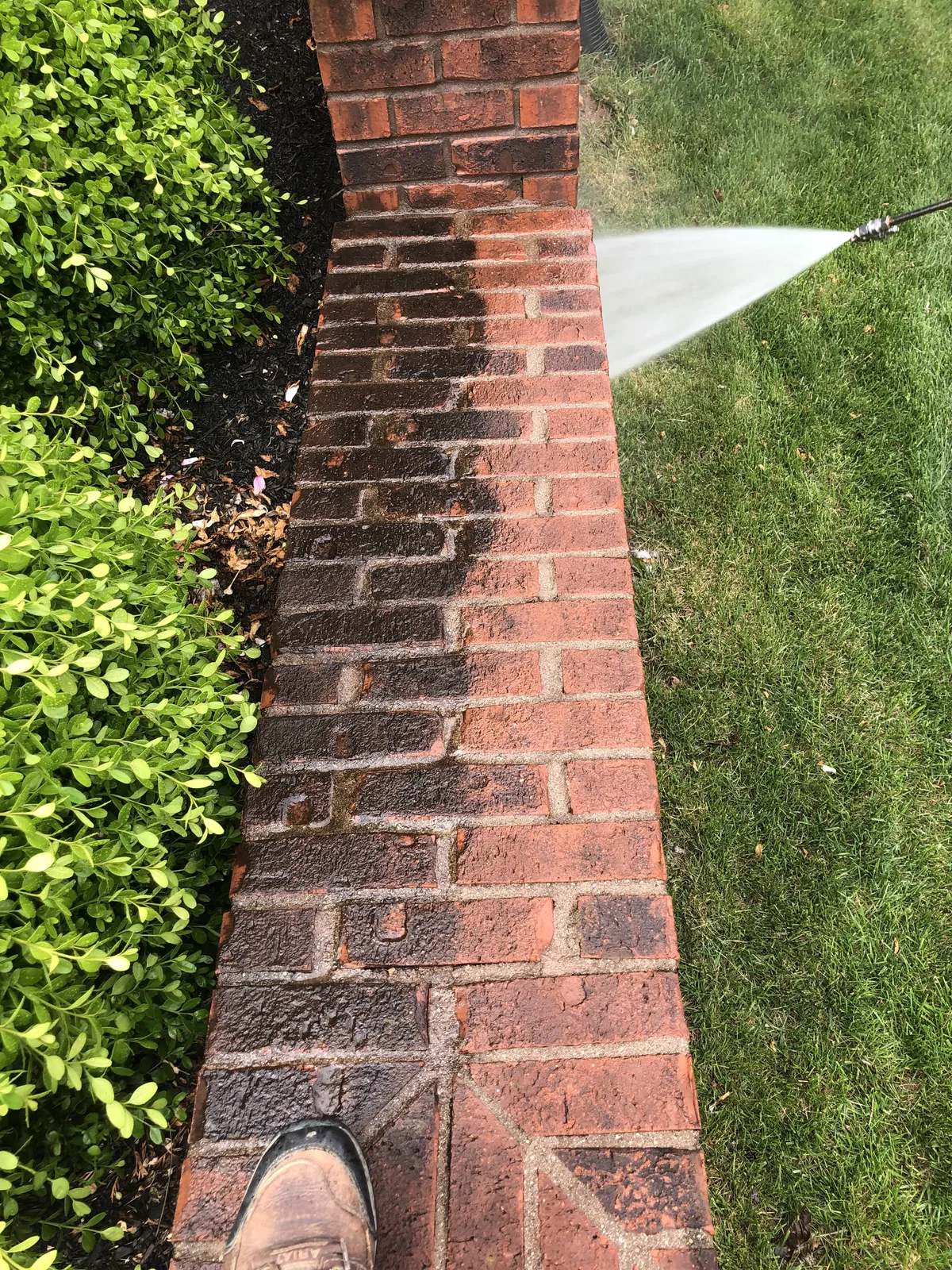
This is the question we get more than any other — and for good reason. Your landscaping costs money, your dog lives outside, and your kids play in the yard. Here's the straight answer about how professional soft washing actually works around your landscaping and family.
The short answer
Yes — professional soft washing your house, done correctly, is safe for your plants, pets and children. The key qualifier is "done correctly." The chemicals used in soft washing can harm plants if they're not properly diluted, if they're allowed to sit on foliage without rinsing, or if runoff pools around plant roots. A professional crew knows exactly how to prevent all three of those scenarios.
Here's the full picture of what we do and why it works.
What's actually in soft wash solution?
The primary active ingredient in professional soft washing is sodium hypochlorite — the same chemistry as household bleach, but in a diluted, surfactant-enhanced formulation designed for exterior surfaces. At the concentrations used for house washing (typically 0.5–1.5% sodium hypochlorite by the time it reaches the surface), the solution is effective against mold, mildew and algae while being manageable around landscaping with proper precautions.
Professional solutions also contain surfactants (soap-like compounds that help the solution cling to vertical surfaces and penetrate biological growth) and sometimes neutralizing agents. These are biodegradable and break down quickly once diluted and rinsed.
What we do before the cleaning starts
Before any solution is applied to your home, a careful crew will:
- Pre-wet all surrounding landscaping: Thoroughly saturating the plants, soil and mulch before the cleaning begins creates a dilution buffer. When soft wash solution reaches pre-wetted foliage, it dilutes further and slides off rather than concentrating on leaves.
- Tarp or cover sensitive plants when needed: Certain plants — particularly herbaceous perennials, ferns, certain ornamental grasses and newly planted specimens — are more sensitive than established woody shrubs. We cover these when they're in the direct spray zone.
- Adjust application angle: We apply solution away from plant beds whenever possible and never apply directly into planting areas.
During the cleaning
Throughout the cleaning process, we rinse foliage in the work area continuously when conditions warrant — particularly on hot, sunny days when solution can dry on leaves before we rinse the house. The goal is to keep any solution that reaches plants diluted and moving, not concentrated and sitting.
After the cleaning
The final step on every job is a thorough post-rinse of all surrounding landscaping, mulch beds, hardscape surfaces and any areas where runoff may have collected. This ensures the cleaning solution is diluted to safe levels and cleared from the site. By the time we pack up, there's no residual chemistry to concern you.
What about pets and kids?
The simple rule: keep pets and children inside or in a separate part of the yard while the cleaning is actively underway. There's no need to stay away from the property for hours — once we've completed the final rinse and you can see that everything is rinsed down, the treated areas are safe.
The one scenario to be thoughtful about: if you have a dog that drinks from puddles or eats grass, keep them away from the work area until everything has dried. Once the surfaces are dry and the rinse has run off, there's no meaningful chemical residue. We'll let you know when everything is clear.
Plants that need extra care
Most established woody landscaping — boxwoods, hollies, azaleas, ornamental grasses, hostas, daylilies, junipers — handles the pre-rinse/post-rinse protocol well. Plants that warrant extra attention:
- Vegetable gardens and herb beds (keep solution well away from edibles — we use tarps and careful application angles)
- Newly planted specimens (root systems not yet established, more stress-sensitive)
- Japanese maples and other moisture-sensitive ornamentals
- Any plant that's already stressed from drought, disease or pest damage
If you have plants you're particularly concerned about, point them out during the estimate walkthrough. We'll plan the cleaning approach around protecting them.
What about the cleaning smell?
You'll notice a faint chlorine scent during the cleaning. It's the same smell as a freshly cleaned pool or a load of laundry — not pleasant in concentration, but not harmful at the levels present during a house wash. It dissipates completely within a few hours as the solution dries and breaks down. By the time we leave, the smell is largely gone.
The bottom line
A careful, experienced crew can wash a home from foundation to soffit without harming a single plant — and we do it every day — Louisville pressure washing and soft washing across the Kentuckiana region. The plant damage we occasionally hear about from homeowners who had bad experiences elsewhere almost always comes from one of three things: no pre-rinse, no post-rinse, or too-high concentration applied carelessly. None of those are acceptable professional practices.
If you want to see our process in person before committing, you're welcome to be present for the estimate and the cleaning. We have nothing to hide about how we work.
Call or text (502) 777-8024 or use the quote form to schedule your estimate.
The science of why dilution is the key
Sodium hypochlorite — the primary active ingredient in soft wash solutions — is toxic to plants at concentrated doses because it disrupts the chlorophyll molecule and damages cell membranes. But concentration is everything. The same sodium hypochlorite at household bleach concentration (3–8%) is toxic. At the 0.5–1.5% concentration that reaches a plant after dilution during a soft-wash application, it causes minimal stress to established plants — particularly when those plants are pre-wetted before cleaning begins.
The pre-rinse step works by two mechanisms: it saturates the plant tissue so the sodium hypochlorite is immediately diluted on contact, and it washes most of the solution off foliage before it can absorb. The post-rinse removes any remaining residue. Between the two rinses, established plants receive minimal effective chemical dose — comparable to what they might encounter from a neighbor's pool that has backwashed, or from a runoff event after heavy rain on treated surfaces.
This is why professional technique matters so much for plant safety. An operator who skips the pre-rinse or applies concentrated solution directly to foliage can cause plant damage. One who follows proper procedure causes essentially none.
Specific plants we pay extra attention to
Louisville yards run from the mature oaks and ornamental gardens of Anchorage to the tight urban lots of the Highlands. These are the plants that need extra care:
- Japanese maples: These are the plant we hear about most from concerned Louisville homeowners. Japanese maples are more sensitive to chemical stress than most ornamentals. When they're within the spray zone, we cover them with plastic sheeting during the active cleaning phase and are extra thorough on post-rinse.
- Hosta beds along foundations: Hostas are common foundation plantings in Louisville and are often directly against the home's base — right where cleaning solution rinses off the siding. We pre-wet heavily, work quickly, and ensure the post-rinse is thorough. Established hostas handle this protocol well.
- Herb gardens and vegetable beds: We treat edibles with maximum caution. We won't apply solution within 3 feet of a vegetable or herb garden without covering it first, and we never rinse edible plants with solution-contaminated runoff. If you have raised garden beds adjacent to the home's foundation, point them out before we start.
- Newly planted specimens: Plants installed within the last growing season have smaller, less-established root systems and are generally more stress-sensitive. They get extra pre-rinse time and we're careful to keep solution away from their root zones.
What about lawns and grass?
Grass areas adjacent to driveways, walkways and foundations are a common concern. The question is whether cleaning solution or pressure-wash runoff reaching grass causes damage. The practical answer: with proper dilution from a thorough post-rinse, established grass handles the brief chemical contact from a soft-wash job without significant harm. Lawn areas immediately adjacent to a concrete driveway being pressure-washed may experience some splash, but the low volume and immediate dilution from any dew or soil moisture are sufficient protection for healthy turf.
The scenario to be cautious about: if a concentrated cleaning solution pools in a low spot in the lawn — say, in a depression near the foundation — and doesn't disperse quickly, it can cause bleaching or browning of the grass in that specific area. We watch for this during the cleaning and will redirect flow or dilute with additional water in any areas where pooling could occur.
Pets: what's actually safe and when
The straightforward answer: keep pets out of the immediate work area during the cleaning, and for about an hour after — mainly to let surfaces dry. Once the surface is dry, there's no residual chemical that poses a risk to a dog who sniffs it or briefly contacts it. The concern is during active application, when a dog walking through the area could get concentrated solution on paws or coat.
For cats who tend to stay indoors anyway, there's typically no concern. For dogs who live outside or have free roam, keeping them on the opposite side of the house from where we're actively working — or inside during the 2–3 hours of the job — is the simple solution. We'll let you know when we're wrapping up so you can let them back out.
Ask us about any specific concern before we start
Every yard is different, and we'd rather hear about a rare plant, a recently seeded lawn area, or a sensitive specimen before we begin than try to address damage after the fact. During the estimate walkthrough, point out anything you're concerned about and we'll plan our approach around it. There's no adjustment that a careful professional can't accommodate — and most of the time, the concern turns out to be simpler to address than the homeowner expected.
Call or text (502) 777-8024 or use the online quote form to schedule your estimate. We serve Louisville, St. Matthews, Prospect, Jeffersontown, Middletown, New Albany, Jeffersonville and the full Kentuckiana region.