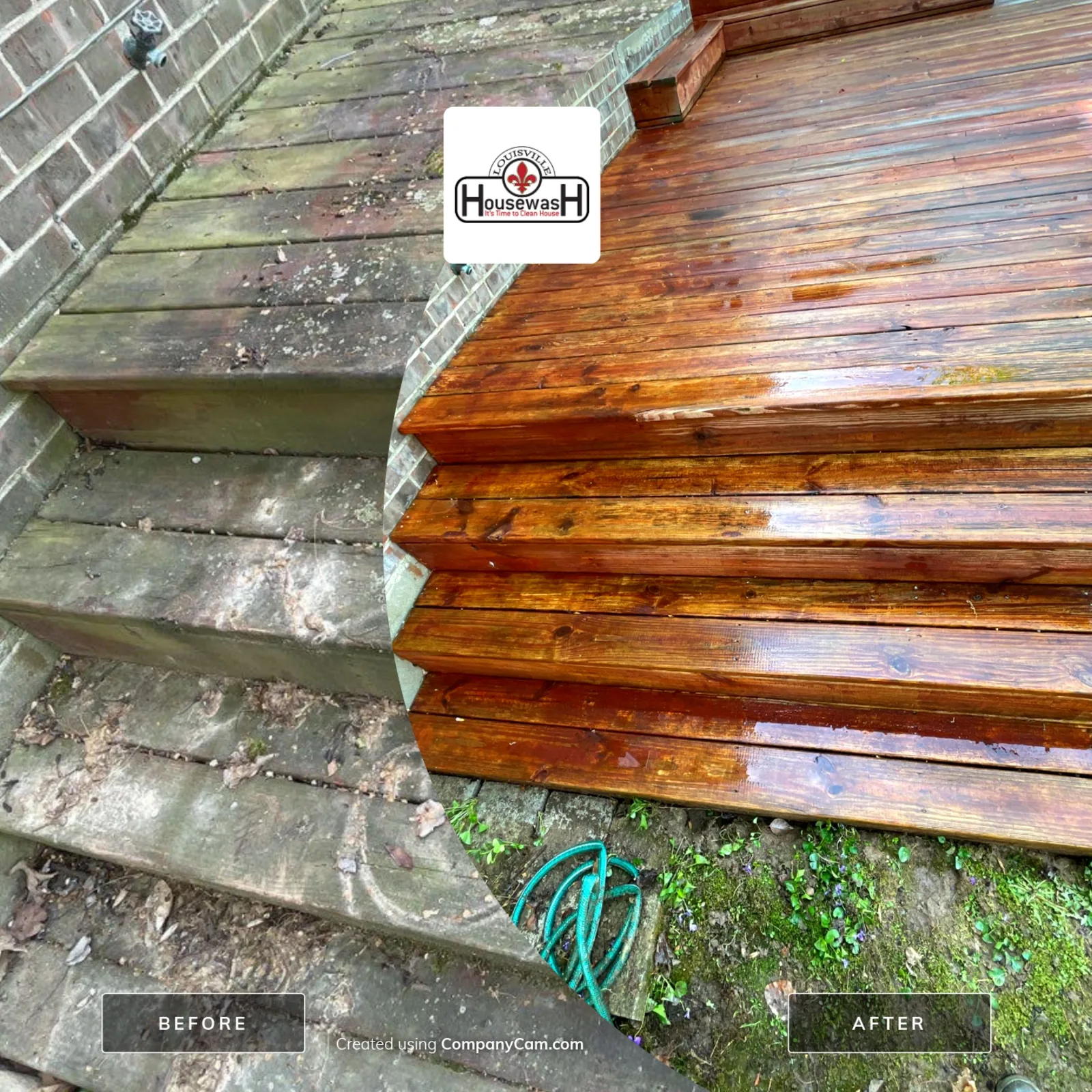
Stain only sticks to clean, properly prepped wood. The number one reason deck stain fails early? It was applied to a deck that wasn't properly cleaned. Here's the exact step-by-step process our crew uses on deck and fence cleaning in Louisville to prep wood so the new finish actually lasts. Updated for the 2026 staining season.
Why deck prep is more important than the stain itself
Louisville homeowners spend real money on quality deck stains — Defy, Armstrong Clark, Cabot, TWP — and then apply them to wood that hasn't been properly cleaned and brightened. Within a season or two, the stain is peeling, flaking, or wearing unevenly. The stain gets blamed, but the prep was the problem.
Paint and stain are adhesion products. They bond to whatever surface they're applied to. If that surface has UV-damaged wood cells (gray oxidation), old failed stain, biological growth, dirt or mill glaze from manufacture, the new finish bonds to those contaminants rather than the wood itself. The result is a finish that fails from below rather than from normal wear from above.
We've re-prepped enough failed staining jobs across Louisville to say this plainly: the prep is 80% of the outcome. Get the prep right and any decent stain will last. Get the prep wrong and even the best stain fails early.
Or don't do it yourself
Worth saying plainly before you spend a weekend on this: we do this job. Cleaning and staining, both halves, in Louisville and across Kentuckiana.
The guide below is genuinely how to do it properly if you want to — the prep is most of the work and getting it wrong is what makes stain peel a year later. But if you'd rather not spend a Saturday on a deck and a Sunday waiting for it to dry, call or text (502) 777-8024 and we'll quote it.
Either way, read the drying-time section. It's the step almost everyone gets wrong.
The 5-step prep process (in order)
This is the exact sequence our crew follows on every pre-stain deck prep. Skip a step and you'll pay for it at re-coat time.
- Clean: Clear the deck, apply a wood-safe cleaner, let it dwell, then soft wash it away.
- Repair: Set popped fasteners, replace rotten boards, tighten railings — while the deck is still empty and inspectable.
- Sand: Light sanding of raised grain and any spots the cleaner didn't fully strip.
- Dry: 48–96 hours depending on Louisville's weather that week. Confirm with a moisture meter.
- Stain: Apply the stain on a mild day with no rain in the forecast for 24 hours.
Each step is expanded below.
Step 1: Clear and inspect
Move all furniture, planters, grills, potted plants and any other items off the deck and away from the perimeter. This isn't just about cleaning access — it's an opportunity to inspect the deck while it's empty.
Look for: popped nails or screws that need to be set flush, soft or spongy boards that indicate beginning rot, loose railings, wobbly post bases, and cracked or split boards. All structural repairs should happen before cleaning, not after. Getting the deck wet and then doing construction work disturbs the prep and potentially introduces new staining.
Step 2: Apply a wood-safe cleaner
The right cleaner depends on the wood's condition and what you're dealing with. For most Louisville decks, a professional wood cleaner containing sodium percarbonate lifts the gray surface layer, kills biological growth, and breaks down old failed stain or sealer.
Apply the cleaner generously and allow it to dwell — typically 10–15 minutes, depending on the product and conditions. During dwell time, the chemistry is working: breaking down the gray oxidized layer, killing mold and mildew, and loosening whatever is on top of the wood. Rushing this step is the single most common cause of poor prep results.
Do not let the cleaner dry on the wood. If you're working in hot, sunny conditions, keep the wood damp by misting it while the cleaner dwells.
Step 3: Soft wash the deck — don't blast it
Low pressure with the right cleaner does the work. A pressure wand at full power on softwood like pine or cedar will raise and splinter the grain — creating a fuzzy, uneven surface that stain absorbs unevenly and that splinters underfoot. Even on hardwoods, excessive pressure can cause checking (grain cracking) and surface damage.
Professional soft wash equipment uses low pressure to rinse the cleaner and lifted material away from the wood surface without damaging the grain. The correct technique: rinse parallel to the wood grain, not across it, at consistent distance from the surface.
Step 4: Brighten the wood
This step is what separates a professional prep from a DIY job that looks mediocre even after staining. A wood brightener — typically an oxalic acid or citric acid formulation — neutralizes the alkaline cleaner and restores the wood's natural pH. More importantly, it chemically lifts the remaining gray tannins and oxidation, returning the boards to their natural warm tone.
Applied after cleaning and rinsed thoroughly, a brightener makes the wood look like it was just milled. The color is even, the grain is open, and the surface is chemically prepared to accept stain or sealer at maximum penetration depth. Without this step, the wood looks clean but remains slightly gray and the stain doesn't penetrate as deeply or hold as long.
Step 5: Sand any raised grain
Even a careful soft wash raises some grain, especially on softwoods and older decks. Once the wood is dry, do a light sanding pass with an 80–100 grit sanding pad on a random-orbit sander. You're not trying to strip the surface — just knocking down the fuzz so the deck feels smooth underfoot and the stain lays down evenly.
Focus on high-traffic areas, the tops of railings and the leading edge of each board. Sweep or blow off all sanding dust before staining begins.
Step 6: Let it dry — really dry
This is the most commonly rushed step in the entire process. Stain applied to wood that still has elevated moisture content — even if it looks dry on the surface — will trap moisture beneath the finish and cause peeling within a season.
The general rule for Louisville's climate:
- Warm weather (above 70°F), low humidity: 48 hours after cleaning
- Moderate weather (55–70°F), typical humidity: 48–72 hours
- Cool weather or high humidity: 72–96 hours or until moisture meter reads below 15%
A moisture meter is the definitive tool here. Most professional painters and stain applicators carry one. If you're doing this yourself, they're available at hardware stores for under $30 and tell you definitively whether the wood is ready.
Step 7: Apply the stain
Pick a day with temperatures between 55°F and 85°F, no direct sun on the deck during application if possible, and no rain in the forecast for 24 hours. Louisville's spring and early fall generally have more of these windows than midsummer. Follow your stain manufacturer's application instructions exactly — brush, roll or spray as they specify, and don't over-apply. Two thin coats almost always outperform one thick coat.
Cleaning method comparison: what actually works
Homeowners planning to stain a deck usually consider three cleaning approaches. Here's how they compare in real Louisville conditions:
- Professional soft wash with brightener: Low pressure, wood-safe alkaline cleaner, oxalic acid brightener, controlled rinse. Kills biological growth at the root, strips gray oxidation, opens the grain, doesn't damage wood. This is what we do — and it's what any pre-stain prep really needs. Results last 5–7 years when paired with a quality stain.
- Rental power washer: High pressure (2,500–3,500 PSI), water only. Cleans surface dirt, doesn't kill biological growth (regrowth in 3–6 months), routinely raises and splinters softwood grain. Even with a wide nozzle and careful technique, the pressure is too high for most Louisville decks. Stain applied over power-washed wood often peels within 12–18 months.
- Store-bought deck cleaner and a scrub brush: Products like Behr All-in-One or Thompson's WaterSeal deck wash, applied with a pump sprayer and worked in with a stiff brush. Works reasonably well on light gray weathering and mild biological growth. Struggles on decks with heavy mildew, old failed stain, or dense wood grain that traps dirt. Requires significant labor for anything beyond a small deck.
For a deck that's actually going to be stained, the soft wash plus brightener approach is the only method we recommend without qualifiers. Anything less compromises the final stain job.
Common mistakes we see on Louisville decks
The re-work calls we get after failed staining projects almost always trace back to one of these:
- Staining over gray, un-brightened wood. The deck was cleaned but the brightener step was skipped. The stain looks fine at first but wears unevenly and looks faded within a year.
- Staining while the wood is still damp. The surface looked dry, but a moisture meter would have read 20%+ below the surface. The stain traps that moisture, blisters, then peels.
- Power washing at full pressure. The homeowner rented a pressure washer with a 15° tip and cleaned the deck. The grain is raised and splintered. The stain application looks streaky no matter how carefully it goes on.
- Skipping repairs. The deck got cleaned and stained around a soft board that should have been replaced. Six months later the board fails and the stain around it looks worse than the rest of the deck.
- Applying too much stain. "More is better" doesn't apply to stain. Over-application leaves a sticky, tacky surface that doesn't cure properly and picks up dirt for months.
- Ignoring the weather forecast. Rain within 24 hours of staining washes off uncured stain. In Louisville's spring and summer, always check the 48-hour forecast before starting.
If you're weighing DIY prep against a professional job, the honest calculus is on our deck cleaning cost guide — most Louisville homeowners come out ahead by paying for professional prep and doing the staining themselves, or bundling everything with a painter.
Choosing the right stain type after cleaning
A properly cleaned and brightened deck is ready to accept any stain or sealer product, but the choice of product affects how long the results last and how the deck looks. The main categories:
- Penetrating oil stains (TWP, Armstrong Clark, Defy): These soak into the wood rather than sitting on top. They enhance the natural grain, provide UV protection, and are relatively easy to re-coat — you clean and reapply without stripping. They're the most popular choice for horizontal deck surfaces that take heavy foot traffic and UV exposure.
- Film-forming stains (most latex deck stains): These create a film on the wood surface. They can provide more color coverage but peel as they age, requiring more prep work at recoat time. Better for vertical surfaces like fence rails that don't take foot traffic.
- Clear sealers: Water repellency without significant UV protection. Fine for under-covered decks, but unprotected wood exposed to full sun will still gray out with UV radiation even with a clear sealer. Best combined with a UV-inhibiting formula.
Your stain applicator will have a product recommendation. The most important thing from the prep side: whichever product you're using, it will perform significantly better on a properly cleaned and brightened surface than on one that was just pressure-rinsed.
Understanding the gray: what's actually happening to your deck
That gray color that wooden decks develop isn't just weathering in the atmospheric sense — it's the combination of two distinct processes. First, UV radiation breaks down lignin, the natural polymer that gives wood its strength and warm color. The lignin oxidizes and washes away with rain, leaving the gray cellulose fibers on the surface exposed. This is the "silvering" that untreated wood develops — it's the natural aging process of wood fiber.
Second, biological growth — mold, mildew, algae and the organic compounds they produce — establishes itself in the porous surface of weathered wood. The gray you see is often a mixture of oxidized wood fibers and biological contamination. These two processes reinforce each other: oxidized wood is more porous and absorbent, making it more hospitable to biological growth; biological growth further breaks down the wood surface.
The wood brightener step in professional prep reverses the oxidation component — it chemically strips the gray surface layer and restores the original warm wood tone. This isn't cosmetic; it's structural prep. The restored surface has a more consistent color and an open grain structure that accepts stain evenly and penetrates deeply.
Composite decks: not maintenance-free
One persistent myth among homeowners: composite decks are maintenance-free and never need cleaning before staining or re-coating. This is incorrect on both counts.
While composite decking doesn't gray out the way wood does, it does develop mold and mildew growth — particularly in the grooves between boards and on the shaded undersides of rails. Many composite products also develop surface staining from tannin and organic runoff. Composite manufacturers universally recommend cleaning with approved solutions; most void warranties on products stained or coated over contaminated surfaces.
If your composite deck has a pigmented coating or you're planning to apply one, the cleaning and prep requirements are similar to wood: clean thoroughly, ensure no biological growth remains, and let the surface dry completely before applying any product. Check your composite manufacturer's specific recommendations before we start — some composites have restrictions on what cleaning solutions are safe to use.
Scheduling around Louisville's weather
The ideal window for deck cleaning and staining in Louisville is late spring (May) or early fall (September–October). These periods offer temperatures in the 55–75°F range, lower humidity than midsummer, and more predictable dry windows for the drying phase between cleaning and staining.
Midsummer cleaning and staining is possible but requires more careful scheduling around afternoon thunderstorms, which are a regular feature of Kentucky summers. We'll coordinate with your stain applicator on timing — the goal is a clean surface that has 48–72 dry hours before the first coat goes down.
What we do differently for pre-stain prep
When we clean a deck that's going to be stained, we add the brightener step that's often skipped on standard cleanings, pay extra attention to ensuring all old failed stain is removed (anything that's peeling or flaking needs to come off completely), and communicate clearly with the painter or stain applicator about drying time expectations. We plan the drying window around Louisville's humidity rather than a generic label recommendation.
Getting it done for you
If you've read this far and decided it's more work than you'd like, that's usually the right call — deck prep is the unglamorous half of the job and it's where the result is actually won or lost.
We clean and stain decks and fences across Louisville, Prospect, St. Matthews, Shelbyville and the wider Kentuckiana region. We wash the wood, let it dry properly, then come back and stain it. Free on-site estimate, and cleaning and staining are quoted separately so you can see exactly what each part costs.
Call or text (502) 777-8024, or see our deck and fence cleaning and staining service.